MA in Critical Studies

Blend theoretical knowledge with practical application. Examine society, history, culture, and the arts with an MA in Critical Studies.

Program Snapshot

Master of Arts

Graduate

45

2 Years

Portland

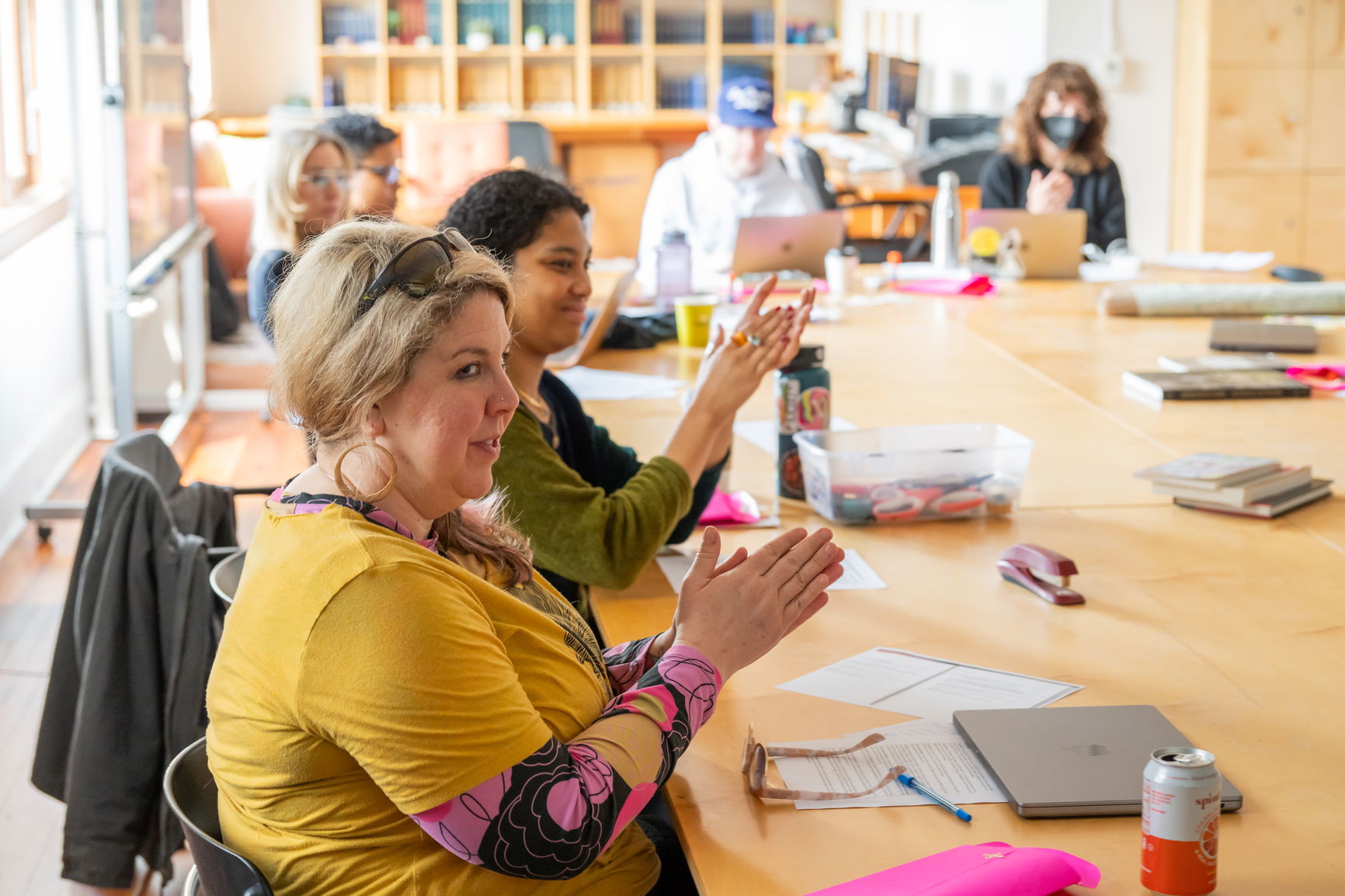
Students sitting at a table paying attention to a lecture.

Our Critical Studies MA Program

The Critical Studies MA explores the structures, ideas, and cultural influences that shape human experience through the study of art and society. The program works in the generative space where critical theory and cultural studies overlap.

Students engage with topics such as identity, social systems, and cultural frameworks while developing analytical, research, and writing skills that transfer directly into professional work. Graduates leave with a deeper understanding of cultural dynamics and critical inquiry, prepared for careers in research, education, communications, advocacy, and the arts.

Why choose an MA at Pacific Northwest College of Art?

  • Build professional skills. An MA (Master of Arts, a research and writing-based graduate degree) in Critical Studies emphasizes skills valued across many professions: clear writing for different audiences, independent research, evidence-based argument, editing, and the analysis of complex information.
  • Experience our thesis writing retreat. Our thesis writing retreat is unlike anything else in graduate education. Students spend multiple days with faculty, workshopping ideas in intensive dialogue and quiet focus.
  • Learn from visiting scholars. Prominent artists, writers, scholars, and critics come to campus every year to lead discussions and give lectures that enhance students' education and professional networks.
  • Collaborate across disciplines. Study alongside MFA students in Visual Studies, Printmaking, and Creative Writing. Access PNCA's Creative Technology Lab for digital projects, or pursue our three-year dual MA/MFA degree.
Schedule a Visit

Request Information

Do you have questions about the Critical Studies program at PNCA? Fill out this form and we'll get in touch!

Loading...

Eileen Isagon Skyers MA '14 had the opportunity to share her thoughts on a global stages at TED2023. Her talk, entitled "In the age of AI art, what can originality look like?," focused on a particular area of interest for Eileen -- the intersection of art and AI.

Eileen's Story

Eileen Isagon Skyers MA’14 speaks about the intersection of art and AI on the TED2023 stage

Eileen's TedTalk -- which focused on the way artists can use machine learning in their creative work -- is part of the evolution of the field of critical studies as it explores new possibilities and approaches to art. She discussed how the emergence of digital art has removed gatekeepers in creative spaces and provides opportunities to marginalized voices.

View Story
Eileen Isagon Skyers
Eileen credits the rigorous and professional environment of PNCA's Master's program with preparing her to present her ideas publicly.

Student Work

Throughout their time in the program, Critical Studies students explore a range of topics that culminate in a thesis project. The thesis is a capstone, meaning a substantial final project that draws together everything from the degree. It can take the form of a paper, a research project, or a hybrid, allowing students to pursue meaningful topics and follow unique threads of inquiry.

Alumni Stories

Alumni of the critical studies graduate program have used their professional skills and cultural awareness to secure a variety of roles. They apply their knowledge of public engagement, diverse writing, and academic presentations to a range of careers in creative fields, administration, advocacy, education, and community engagement. Learn more about the wide ranging benefits of a master of arts degree.

  • Sean Yeager

    Sean Yeager is a Visiting Assistant Professor of Science and Nature Writing at Kenyon College. Their data-driven visualizations of narratological temporal structures received the Paul Fourtier Prize for best paper by an emerging scholar at the 2019 Digital Humanities Conference. Their research on neurodivergent reading practices received honorable mention for the Nadal Prize at the 2022 International Conference on Narrative, and their theorization of autistic temporalities received honorable mention for the Bruns Prize at the 2024 meeting of the Society for Literature, Arts, and the Sciences. Sean studies contemporary literature through the lenses of narrative theory, digital humanities, and disability studies.

    Sean Yeager
  • Ashley Hollan

    Ashley Hollan

    Ashley Hollan, a visiting assistant professor in the Art Department at Elon University, holds multiple degrees, including a master of fine arts in Visual Studies from the Pacific Northwest College of Art. She has owned a law firm focusing on entertainment law and criminal defense, worked with Live Nation, and currently provides freelance consulting for creative and legal projects. She has notable nonprofit and leadership contributions including awards from the American Bar Association.

Faculty

PNCA faculty members have extensive experience as artists, scholars, critics, and speakers. They offer one-on-one mentorship and guidance so each student's education is customized to their goals. We also bring in guest speakers for panels, lectures, and events, giving students opportunities to connect and learn more.

Faculty

Curriculum

In the Critical Studies program, students adopt an interdisciplinary approach to examining society, history, culture, and the arts, with a strong focus on power structures, ideologies, and social constructs. Critical lenses include feminist theory, queer theory, critical race theory, and post-colonial theory. Students develop strong writing skills that translate to many professional fields.

  • Crit 501 Critical Theory 1: Introduction

    This course will introduce students to foundational concepts, thinkers, and trajectories in critical theory with the aim of understanding what critical theory is, and how students can best utilize it in their own scholarly and creative interests. The course begins by surveying topics such as capitalism, psychoanalysis, and power before turning our attention to race, (settler/de)colonization, gender, sexuality, aesthetics, and affect. At the end of the course, students will be equipped with key theoretical and conceptual vocabularies.

  • Crit 521 Introduction to Cultural Studies

    This course will introduce students to foundational concepts, thinkers, and trajectories in critical theory with the aim of understanding what critical theory is, and how students can best utilize it in their own scholarly and creative interests. The course begins by surveying topics such as capitalism, psychoanalysis, and power before turning our attention to race, (settler/de)colonization, gender, sexuality, aesthetics, and affect. At the end of the course, students will be equipped with key theoretical and conceptual vocabularies.

Program Requirements

The MA in Critical Studies requires completing core courses including Critical Theory, Cultural Studies, and Critical Writing, along with specialized subjects like Queer and Feminist Theory and Environmental Criticism. Students also engage in Creative Nonfiction Writing, an Internship, and Critical Race Theory. The program culminates with a two-part thesis and a Professional Practice course. Electives allow for tailored academic exploration.

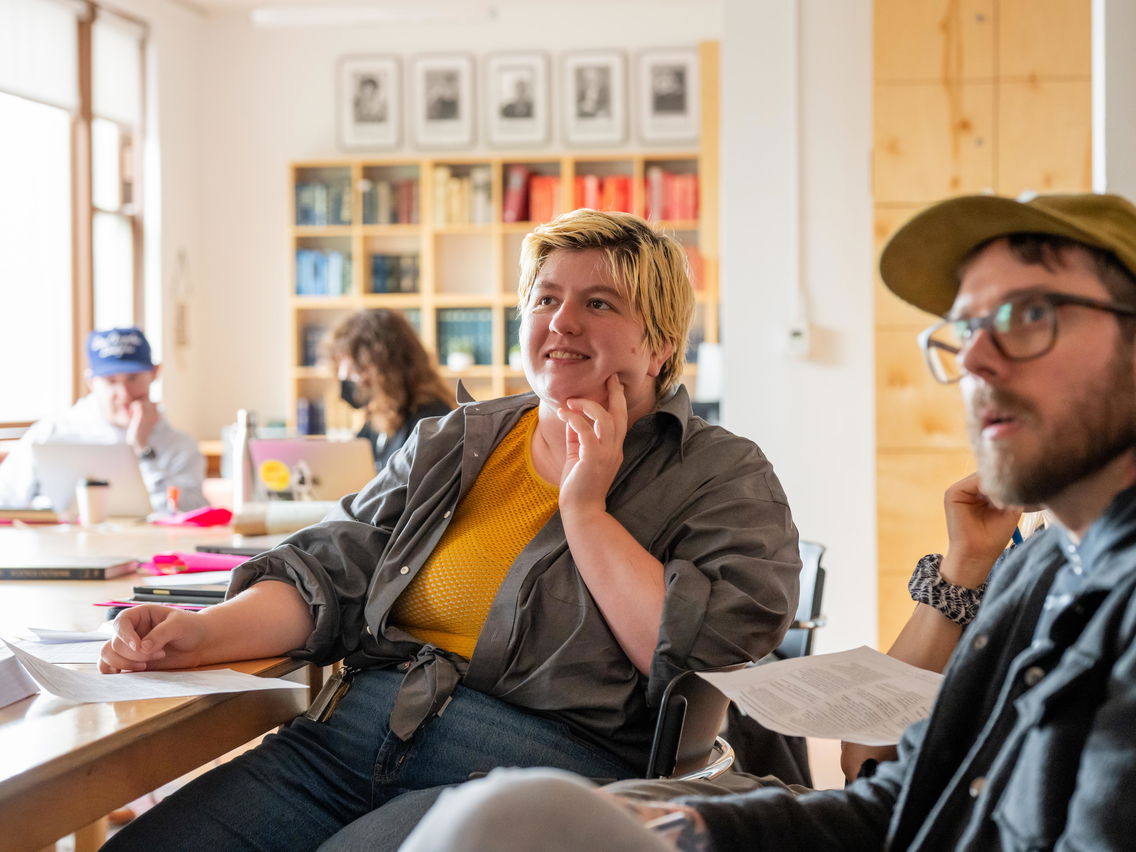
A person with curly hair sitting at a table with people in the background.

Admissions Information

Our MA program is designed for students who want to become socially engaged critical thinkers. Ideal candidates include:

  • Humanities and social science scholars seeking to strengthen their skills and portfolios for further graduate education
  • Emerging cultural critics seeking to sharpen their critical eye and develop their practice
  • Practicing artists and creative writers seeking to develop projects in a critically rigorous and collaborative learning community
  • Dedicated activists seeking to deepen their intellectual roots in service of their political commitments

Prior coursework in critical theory is not required.

The technology lab at PNCA

Financial Aid & Scholarships

Hallie Ford School of Graduate Studies offers renewable Merit Scholarships to students who demonstrate aptitude in their areas of creative practice. Merit scholarships are assessed based on the strength of the student’s application. In awarding merit scholarships we consider each student’s portfolio (if applying to a studio-based program), personal history of scholastic achievement, as well as their contributions to culture and community. No separate application is required to be considered for merit scholarships.

A classroom of students sitting with their hands together above the table.

FAQs

Critical studies examines art's cultural, social, political, and historical contexts, challenging traditional views and expanding our understanding of art. As a discipline, it encompasses frameworks such as feminism, post-colonialism, queer theory, and critical race theory. Critical studies considers the role of art in history, culture, and society, and how art can go beyond conventional uses to affect change.

Graduates are positioned for diverse professional pathways. The degree does not train students for one job title. It builds a set of skills, in writing, research, analysis, and communication, that organizations across sectors need and struggle to hire for.

  • Administration. Organizational and analytical skills apply across arts, nonprofit, and institutional settings.
  • Advocacy and community engagement. Apply research and communication toward social change and stronger communities.
  • Communications and public relations. Convey complex ideas effectively in business, creative, technical, grant, or report writing.
  • Curation and exhibitions. Influence public discourse through art and culture.
  • Diversity, equity, and inclusion. Bring a deep understanding of societal structures into organizations.
  • Editing, education, instructional design, learning and development, and research. Fields where critical analysis, communication, and innovative thinking are highly sought after.

These varied pathways reflect the program's emphasis on versatile, real-world skills.

No. Students arrive from studio practice, organizing, and a range of undergraduate majors. The theory seminars build vocabulary from foundational concepts forward, and the whole program reads together, so no student is the only one encountering a text for the first time.

A supervised professional placement, typically with an arts organization, nonprofit, publication, museum, or educational institution. Students take on real responsibilities, build a portfolio and references, and test career directions before graduating.

  • Symposium. Our annual event features a student work exhibition, keynote speakers, workshops, and discussions led by Critical Studies students. It is also a professional presentation credential.
  • Dual MA/MFA degree. Pair the MA with an MFA in Printmaking or Visual Studies over three years.
  • Thesis writing retreat. During the second year, students join faculty for a multi-day retreat.
  • Visiting scholars. Throughout the year, visiting writers, scholars, and artists enliven conversations and inspire students.
  • Facilities. Complete research in the Albert Solheim Library or use one of the labs and workshops on campus.

Culture

Theorizing: mediation, interpretation, and cultural production through a wide range of theoretical texts and cultural objects. Students will gain familiarity with literary studies and visual studies, as well as different schools of cultural studies, including Frankfurt and Birmingham.

  • Theodor Adorno, Minima Moralia
  • Sara Ahmed, The Cultural Politics of Emotion 
  • Roland Barthes, “The Death of the Author” + Mythologies
  • Walter Benjamin, Illuminations 
  • Lauren Berlant, Cruel Optimism
  • Pierre Bourdieu, Distinction: A Social Critique of the Judgment of Taste
  • Bertolt Brecht, “Shouldn’t We Abolish Aesthetics?”
  • Sarah Brouillette, Literature and the Creative Economy
  • Teresa de Lauretis, Alice Doesn’t: Feminism, Semiotics, Cinema
  • Frantz Fanon, Black Skin, White Masks
  • Stuart Hall and Paddy Whannel, The Popular Arts
  • Robin James, Good Vibes Only 
  • Fredric Jameson, Postmodernism, or, the Cultural Logic of Late Capitalism
  • Bruno Latour, We Have Never Been Modern
  • Sianne Ngai, Our Aesthetic Categories
  • Olu Oguibe, The Culture Game
  • (ed) Andreas Petrossiants and Jose Rosales, Diversity of Aesthetics
  • Christina Sharpe, Ordinary Notes
  • Susan Sontag, Against Interpretation
  • Hortense Spillers, Black, White, and in Color: Essays on American Literature and Culture
  • Karen Tongson, Normporn: Queer Viewers and the TV that Soothes Us
  • Raymond Williams, Keywords: A Vocabulary of Culture and Society

Power

Theorizing: subjectivity, political economy, and hegemony through a wide range of theoretical and historical texts. Students will also gain familiarity with sociology, ontology, and post-colonial studies.

  • Beatrice Adler-Bolton and Artie Vierkant, Health Communism
  • Giorgio Agamben, Homo Sacer: Sovereign Power and Bare Life
  • Nadia Bou Ali, “Ugly Enjoyment: Affirming life, inconsolably”
  • Louis Althusser, “Ideology and Ideological State Apparatuses”
  • Gloria Anzaldúa, Borderlands/La Frontera
  • Judith Butler, Bodies That Matter: On the Discursive Limits of Sex
  • Aimé Césaire, Discourse on Colonialism
  • Dipesh Chakrabarty, Provincializing Europe: Postcolonial Thought and Historical Difference
  • Melinda Cooper, Family Values
  • Leah Cowan, Border Nation: A Story of Migration
  • Angela Davis, Women, Race & Class
  • Mike Davis, Planet of Slums
  • Mohammed El-Kurd, Perfect Victims: And the Politics of Appeal
  • Sylvia Federici, Caliban and the Witch
  • Michel Foucault, Discipline and Punish
  • David Graeber, Debt: The First 5000 Years 
  • Saidiya Hartman, Scenes of Subjection
  • Max Horkheimer and Theodor Adorno, Dialectic of Enlightenment
  • Karl Marx, Capital: Volume I
  • Nelson Maldonado-Torres, “On the Coloniality of Being”
  • Achille Mbembe, Necropolitics + On the Postcolony
  • Annie McClanahan, Dead Pledges: Debt, Crisis, and Twenty-First Century Culture
  • Fred Moten and Stefano Harney, The Undercommons: Fugitive Planning and Black Study
  • Jonathan Nitzan and Shimson Bichler, Capital as Power
  • Elizabeth Povinelli, Geontologies
  • Cedric Robinson, Black Marxism
  • Edward Said, Orientalism
  • Gayatri Chakravorty Spivak, “Can the Subaltern Speak” + “The Rani of Sirmur”
  • Eric Stanley, Atmospheres of Violence 
  • Mary Turfah, “Complicity: Seeing Everything but Palestinians”
  • Eduardo Viveiros de Castro, Cannibal Metaphysics
  • Jackie Wang, Carceral Capitalism
  • Calvin Warren, Ontological Terror: Blackness, Nihilism, and Emancipation
  • Sylvia Wynter, “Unsettling the Coloniality of Being/Power/Truth/Freedom”

Desire

Theorizing: fantasy, embodiment, and pleasure through a diverse range of theoretical texts and cultural objects. Students will gain familiarity with theories of feminism, performance, and psychoanalysis.

  • Sara Ahmed, Queer Phenomenology 
  • Lauren Berlant and Lee Edelman, Sex, Or the Unbearable
  • Lauren Berlant and Kathleen Stewart, The Hundreds
  • Homi Bhabha, “Of Mimicry and Man: The Ambivalence of Colonial Discourse”
  • (ed) Ann Cvetkovich, Annamarie Jagose, and Heather Love, Rethinking Sex
  • Gilles Deleuze and Felix Guattari, Anti-Oedipus
  • Friedrich Engels, The Origin of the Family, Private Property, and the State
  • Sigmund Freud, Beyond the Pleasure Principle
  • Donna Haraway, The Cyborg Manifesto + The Companion Species Manifesto
  • Jules Gill-Peterson, Histories of the Transgender Child 
  • Alva Gotby, They Call it Love: The Politics of Emotional Life
  • Felix Guattari, The Molecular Revolution 
  • Sarah Jaffe, Work Won’t Love You Back 
  • Julia Kristeva, The Powers of Horror
  • Jacques Lacan, Desire and Its Interpretation
  • Audre Lorde, “The Uses of the Erotic” 
  • Maria Lugones, “The Coloniality of Gender”
  • Erin Manning, The Minor Gesture
  • Jennifer C. Nash, “Pedagogies of Desire”
  • Sianne Ngai, Ugly Feelings
  • Jasbir Puar, The Right to Maim
  • Cassandra Seltman, “Detachment Styles: On Coming to Nothing”
  • Asa Seresin, “On Heteropessimism”
  • Hannah Wang, “The Age of Anesthesia”
  • Jane Ward, The Tragedy of Heterosexuality
  • Kathi Weeks, The Problem With Work

Liberation

Theorizing: resistance, autonomy, and utopia through a wide range of theoretical texts and cultural objects. Students will gain familiarity with theories of decolonization, imagination, and collective power.

  • Combahee River Collective, The Combahee River Collective Statement 
  • Nicole Cox and Silvia Federici, “Counter-Planning from the Kitchen”
  • Frantz Fanon, The Wretched of the Earth
  • Shulamith Firestone, The Dialectic of Sex: The Case for Feminist Revolution
  • Édouard Glissant, The Poetics of Relation
  • Alexis Pauline Gumbs, M Archive: After the End of the World
  • Michael Hardt and Antonio Negri, Multitude 
  • Tobi Haslett, “Magic Actions: Looking back on the George Floyd rebellion”
  • CLR James, The Black Jacobins: Toussaint L’Ouverture and the San Domingo Revolution
  • Fredric Jameson, Archaeologies of the Future: The Desire Called Utopia and Other Science Fictions
  • Robin DG Kelley, Freedom Dreams: The Black Radical Imagination
  • Rosa Luxemburg, “Reform or Revolution” 
  • The Invisible Committee, The Coming Insurrection
  • Herbert Marcuse, An Essay on Liberation
  • Jose Esteban Munoz, Cruising Utopia: The Then and The There of Queer Futurity
  • M. E. O’Brien, Family Abolition: Capitalism and the Communizing of Care
  • Lola Olufemi, Experiments in Imagining Otherwise
  • Nat Raha and Mijke van der Drift, Trans Femme Futures: Abolitionist Ethics for Transfeminist Worlds
  • Kristin Ross, The Commune Form: The Transformation of Everyday Life
  • James Scott, Seeing Like a State
  • Assata Shakur, Assata: An Autobiography
  • Valerie Solanas, SCUM Manifesto
  • Anna Lowenhaupt Tsing, The Mushroom at the End of the World
  • Raoul Vanegeim, The Revolution of Everyday Life

Willamette University

Critical Studies